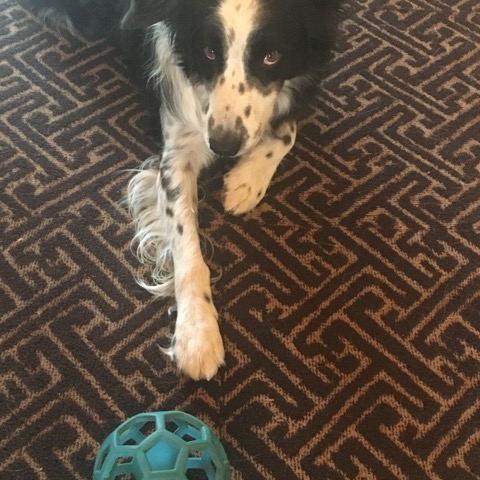
Slice of Life is inspired by the desire and challenge of living our lives in the moment. Days go by, weeks go by, years... but we can still choose over and over again to look at our own lives in small installments. These installments (or slices of life) can be walks taken in the hills, naps or a glass of Rioja. For me, what makes my slices super meaningful is being able to share with others the moments of my day with dogs in play, training or napping where we're all piled up on the bed.

My slices of life are full of events and experiences that are meaningful to me. As a former professional photographer, I still “see” so many pictures (or vignettes) as I interact with my dogs and the world around me on a daily basis. Most of the time I am not capturing these moments with a camera anymore. Instead, I am just showing up... I must say, that I do miss having a register of events outside of my head so that at my leisure I can relish a past moment as I am transported by a visual or written recollection of days gone by.

With the immediacy of all things digital, perhaps I can have my cake and eat it too. I can continue to do my work as a dog trainer and also register here and there moments of living a life in the company of dogs. I hope you will occasionally take a peek, and that my slices of life transport you in a glee of YOUR own!

Showing posts with label dog. Show all posts

Sunday, October 28, 2018

A useful behavior to teach your dog


Most dogs have a fascination with food and any object that smells like food.  They also have predilection for items by which they can exercise their powerful jaws by chewing on them.  And then we have our very naughty pups that love to steal an item and show their owners how smart and cute they are as they run away from them hoping for a fun game of chase.

There are other circumstances in which me must remove an item that can potentially harm the dog, if swallowed.  Either scenario, the best way to deal with all these situations is to teach the dog how to surrender an item voluntarily.  The idea is to teach the dog that when he surrenders something that the dog is now holding in its mouth and under his possession, he will be reinforced for it. In other words, he will get something of HIGHER value for his efforts and compliance.


Time and time again, I meet with owners who have taken by force an item from the dog, only to make the dog now more resistant to giving up what he has and to mistrust that the next item will not be removed by force as well. This can turn into a slippery slope!

The best analogy I can give you is someone telling us that we must surrender our warm ready-to-consume meal because they want it.  Or analogous, having someone constantly reaching into our meal without even asking if they can sample before they are diving in with their fork!  I don’t know about you, but when this happens I make sure the person digging in knows that I do not like people messing with my food!

The motivation for dogs holding on to stuff is the same. They found the item valuable in some way.  Now, if I have someone ask me first if they can sample my food, I would be much more inclined to agree.  The same again is  true for our dogs.

Dogs are genetically wired for survival (like the rest of us) and as such, they are inclined to hold on to any consumable item.  For some dogs this extends to items they are not going to consume, but they like because they can play with them, engage with others (as in the case of the testy dog hoping for a hot pursuit) or even holding on to an item because it gives them a sense of safety.  One of my Springer Spaniels - Chaco, loved to walk  in town holding in its mouth a small carton of cream.  Whenever he found one, he would pick it up and proceed to strut in delight as a passerby would asked me how I taught him that.  I never did, he just decided that walking and holding such an item in his mouth felt good.

My recommendations is to practice exchanges with your dog so that when the need arises your dog will know what to do. Here is how:


  1. Begin by giving your dog an item that he likes but not his super favorite toy, ball etc.
  2. After a couple of seconds of your dog holding the item…
  3. Say “drop it” or whatever verbal cue you want to use.
  4. Wait for 3 seconds and then present your dog with something so delicious that he cannot resist having it.  In order for your dog to eat this, he will have to open its mouth and by defacto drop the item.
  5. Give the dog the treat.


You have, in essence, set things up so that your dog learned that dropping when asked produces something he also wants.  After a few successful trials like this with a so-so object, begin to introduce in this same session or at another time, a more coveted item and repeat as above.

If you teach this to your young puppy, you will be so glad you did!  However, this is one behavior that all dogs can learn at any point. The idea is to practice with enough items of different value for the dog so that the behavior generalizes.

Do know that the longer a dog is holding on to a precious item, the harder it is for him to surrender. Also, if your dog is in any way showing signs of aggression such as growling (when not part of play in chasing, for example) sneering, or stiffness as you try to “negotiate” a surrender it is best to diffuse the situation and not force the dog in anyway to give up the possession. This is most likely resource guarding and it can turn dangerous very quickly.

Resource guarding is normal dog behavior, but one that we must manage like ç or engage in behavior modification where we teach the dog in a more orchestrated manner with some safety mechanisms in place that surrendering is actually a good idea and that it will not be taken for granted.

Last, if you enjoy playing chase with your dog - which I do,  I suggest you put it under stimulus control.  Which means, that you will *ONLY * chase when you say the verbal cue for this game prior to the chasing.  Your dog will learn very rapidly that his efforts in acting super cute with an item will not necessarily give way to chase.

Working with valuable exchanges is a good way to accommodate our dog’s needs and desire for keeping what they like and surrendering when the item it is not safe for them to have  or  when they should not have a particular item.  As always, remember that our dogs must be reinforced for behavior. When reinforcement is not part of the equation, the behavior will go into extinction. That simple.


Saturday, October 13, 2018

Hi-Tech in dog training

John, my husband, is looking for a “new” truck. He is looking in lots of different places just for the “right” truck at the “right” price.  He actually goes and drives a couple that appear to be promising. After one of those drives, he pronounces — in between giggles, that the one he just drove had a cassette player!!  What? No CD player? No bluetooth?  Airbags?  Clearly, he chose to pass on this beauty and continue looking.

As he dove daily into Consumer Reports, car dealership websites, and the like, we discussed perhaps prompted by the cassette player, which “bells and whistles” were  non-negotiable in the purchase of his truck.  It took us but just a few minutes for both to agree on the high-tech modern technologies that the truck needed to have.


I get that not everyone is interested in high-tech. Yet, high-tech is nearly but present in most people’s lives. We are past the point of expecting technologies of all sorts to go away.  As a matter of fact, most of these technologies have brought ample benefits.  Especially so, I would argue, when they are used appropriately. As I like to remind myself: the phone and computer are there for me; versus me for them.  This little reminder most often puts  me on track on how I choose to spend my time. Especially salient, I find unplugged and get uninterrupted time.

Technologies are everywhere.  Even in dog training.  A practice that has very much embraced them. Most trainers that are worth a client entrusting their precious pup to,  are using advance methods that are backed by hard science versus simplistic theories in explaining behavior and most importantly in shaping and modifying behavior.

So why is it then that there are still some folks out there — that almost religiously, continue to expect help from pros that subscribe to obsolete, simplistic models of “alpha” or “leader”?  Can you hear me yawning?

I guess we can blame our big mammalian brain! Our brain loves patterns.  We create patterns perhaps to better understand our environment(s) and keeping ourselves safe. We love to put stuff in categories -  such as the Border Collie, keeping everything neatly in place!  In effect, we must really make an effort to look beyond what appears to be “the facts” to dig deeper and to question claims.

Not only are scientific findings interesting, but I would argue they are also fair (to the species being studied) and very, very helpful to the ones doing the training.  There has been (and we can continue to add to these numbers) over 200 animals species studied. These studies are the foundations of much of what we know about animals and how they learn, relate, feel, etc.  But we still doubt the findings?

Besides the scientific findings, that are the tenets of the science of animal learning and cognition, there are also technologies that have made a big impact in the world of dogs and training.

One that comes to mind is, of course, the clicker. This is one of my ultimate favorite tools AND technologies.  It is a technology because there is much more in the background than the just “click” and “pay” modicum. There is quite a bit that one must understand regarding the science of animal learning if one wants to not only use the clicker (called an event marker) well: click first, pay second, etc.  But we must apply  what we know about how dogs learn  (or your species of choice) and then use the clicker anchored in this learning.

Another great technology is the head-halter.  Think of a head-halter as driving with power steering versus without. You still need to know how to drive the car, but the steering will be much easier.   The same is true for the head-halter.  It can surely aid folks whose dogs are powerful, rowdy on the leash or exhibit big displays of fear/aggression such as lunging at a passerby. However, due diligence must be in place to assure that the owner knows exactly how to use this piece of equipment for effectiveness and kindness to the dog, while the dog must be taught to enjoy wearing the halter because the owner or the trainer have taken the time in paring the halter with fun and positive stuff for the dog.  Enjoy is much better than “tolerate”… I have never liked “tolerating” itchy clothing. Yuck!

I would argue the same about crates.  They can be fabulous in providing dogs with the safety when riding in the car, the flexibility of leaving your dog in a hotel safely in their comfy crates and a personal place for your dog to hang out.  However, the notion that all dogs love crates because they are “den” animals is more fiction than fact. I would argue that all dogs must be taught that the crate is the place to be.  Some will take to it a lot easier for a myriad of reasons while others will never want to be near a crate.

These are but three examples that, in my opinion, have bridge living life with a dog with technologies that make existing with a dog  more pleasurable for the person, and when used appropriately, they can also be a bonus for the dog.

When it comes to training high-tech, we must also pay attention to the thinking behind the practice.  No, not all training is the same.  Yes, dogs are individuals and as such they do have preferences and dislikes but to claim that any dog choose to be pushed around, scared of hurt is plain stupid!

We owe it to our dogs — the ones we claim to be wo[men]’s best friend, to really understand them as a species first and as an individual second.  Not only is this crucial for anyone giving advise about dog behavior, ethology and training but even for dog owners.

Truly, it is time for all of us involved to get our heads out of the sand and educate ourselves in reputable, science-based methods of animal learning as well as  the understanding of canine ethology, instead of simplifying the  factual known nature of our dogs just because we are too lazy to dive deeper.  I guess our brain make us do this!

Sunday, June 17, 2018

Teaching Lie Down To Come Inside or Go Outside

How does your dog tell you that he wants to go out or come in when let outside?   Perhaps your dog is like Rico who would scratch at the door in order to signal he wanted to come inside.

Rico had learned all sorts of new stuff.  The previous week I taught him how to lie down.  This next session we were finally putting the behavior on a verbal cue- which I like to introduce only when the dog is lying down without me having to offer him a food lure. As I arrived to the session and to my surprise, Rico greeted me in his typical effusive manner, but shortly thereafter he did lie down! Some dogs really know how to turn the charm on!

Rico’s “mom” mentioned that she did not like Rico scratching at the screen door to let her know he wanted in.  So, I suggested we try having Rico lie down outside as his signal of wanting to come in. We set it up so that Rico was outside and I remained inside ready to pay him when he would lie down.  I was confident he would lie down in order to be let in.

The reason I thought this was because he had just been reinforced for lying down.  We have ample proof that whatever behavior gets reinforced, will be repeated.  You see, dogs are really smart.  They do what works and they abandon any behavior that is not reinforced in some way. Pretty brilliant, right?

It did not take long before Rico was lying down outside and next to the door. We practiced for a few trials and it took him less and less time with every trial to realize that lying down was the “correct” response to be let in.  I love it when I can find an acceptable behavior for both parties!

Here is how you can teach your dog to stop scratching at the door or even barking, and instead politely lie down to have the door open.

First, you need to make sure your dog has truly learned what lie down (or down) means. You can find out if your dog’s lie down is up to fluency if you ask your dog to lie down and he can comply with at least 85% or more correct answers.  Anything under this requires more practice in order to make the behavior fluent.  If your dog needs a refresher, read below for some tips in teaching him this very handy behavior.


Lure your dog into a down (from a sit) by:
  1. Placing a treat in front of your dog’s front paws.
  2. Treat for lowering the head/neck.
  3. Bending the elbows.
  4. Bending of the knees or at the hip.
  5. Going all the way down.


Use of An Empty Hand Signal:
  1. Remove the treat from your hand and with an EMPTY hand. 
  2. Give your dog the EXACT same hand signal you did while holding food in your hand.  Your dog might hesitate at this point.  Be patient and give your dog time to process.  At this point you can pay your dog for a behavior that he has learned well (like a sit) to keep him interested in continuing working with you.
  3. Reward your dog for lowering the elbows, knees or even the neck at this point. Pay for any of these approximations.
  4. Once your dog is lowering his belly all the way to the ground and has done this consistently for 5 trials, it’s time to introduce the verbal cue lie down or down.

Introducing the Verbal Cue:
When using a verbal cue AND a hand signal it is CRUCIAL that you first give the dog the hand signal and then the verbal cue and not both at the same time.  Dogs will default to minding our body language over verbal cues so if you give both of them at the same time (hand signal and verbal cue) your dog will not learn the verbal cue.

  • Once your dog is fluent in lying down when you ask him to do so, you can ask with abandonment.
  • Practice in different locations inside your home, a café if this is a typical outing for your dog, etc.
  • Occasionally pay your dog for lying down, otherwise the behavior will go into extinction.

Training for Success:
We ALWAYS want our dog to succeed so that we can reward them. Remember that whatever behavior gets rewarded you will see more of.  Please train/practice with the following guidelines below:

Practice each new behavior five times (five trials) in a row.  Depending on the success of your dog for that particular exercise you will…

  • PUSH: If your dog is successful five out of five trials… push to the next step.
  • STICK: If your dog is successful three out of five trials… keep practicing at this level until he/she improves.
  • DROP: If your dog is successful two or one out of five trials…keep practicing at this level until he/she improves.

Now you are ready to generalize the behavior, which means teaching your dog that “lie down” (or down- pick your cue and stick to it) means putting the belly on the ground when you ask in the living room, outside, inside the car.  This is a skill that dogs find challenging so do not skip this step.

Teaching your dog to lie down to be let in:

Make sure you take your dog outside where you want him to eventually lie down and ask for the behavior. Pay handsomely. Repeat a few times.

You can stop here and practice a bit more another day or after a few trials outside, try leaving your dog outside while you go inside and wait for him to lie down on his own.  When he does, open the door immediately and let him in to cash in on the prize.  Repeat a few times making sure your dog gets paid for every correct response besides letting him come inside.  In your next session you can practice with having your dog inside next to you at the door.  It would be easier if you warm him up with a few trials of lying down before requesting the behavior at the door.

In time you can stop paying your dog for lying down when wanting “door services” and use the opening of the door as the reinforcement for him lying down first.

Saturday, January 20, 2018

Are we making our dogs fat by using food in training?

Okay the title is a trick question.  I would argue that yes some dogs are gaining too much weight because they are given too many treats, and perhaps high caloric treats in addition to their daily meals.  A dog that is even a few pounds overweight can be considered obese so it is really important that we do not end up with a very well trained pudgy dog.  Now, there are many dogs that are trained daily and are not fat.
So what is the secret then?  Follow the guidelines below so that you can continue to use treats in training while keeping your dog’s weight in check.

First off, let me explain why reward-based trainers use food so often in training.  Food is one of those things that any living being enjoys and needs.  If your dog is not food motivated as some people claim about their dogs it could be for several reasons, among them are:

1. Your dog has some stomach or GI upset (check with your vet).
2. You are overfeed your dog. Some dogs will actually leave food behind once they are satisfied – this might be your dog.
3. Your dog is really bored with the food you provide and thus eats only enough to keep going – sad
4. The food you give your dog might not agree with him or her.  See # 1.


So, I bet you that if you have your “not so motivated by food” dog skip a couple of meals you will find that now he is more interested in food. Dogs are opportunistic feeders as well as scavengers so in essence their genetic make-up leans more towards eating when you can, rather than having two square meals because they are lucky enough to live with us.

Food in training:  Food is considered really a TOP motivator.  There are others, of course, but in essence any thriving animal has an appetite so this is the main reason why most reward-based trainers use food when teaching new stuff.  Also, food is actually quite practical when it comes to offering a timely reward for behavior and timing is everything in training!

It is important though that when using food as a reinforcer (something your dog really wants or would work for) we keep in mind certain rules.

Rule # 1
You need to consider the amount of food used in training as part of your dog’s daily caloric intake and not in addition to.  In order to do this, you must know how much your dog is getting in treats. Use a measuring cup so that you know how many ounces are going into your training pouch before the session so at the end of the session, or outing you have an idea of how much food was dispensed.  Subtract that amount from your dog’s next meal.

Rule #2
Use your dog’s meals as part of their training chow.  There are a couple of caveats here: You cannot use your dog’s meal if you are feeding “raw” it is just too unpractical.  If you are using kibble (dry food) and your dog likes it you can use this in most trainings scenarios.  However, I would not recommend doing this if you are working on emotional issues such as fear, anxiety or aggression.   See below for more on this.  BTW, most kibble is actually not low in calories so check with your vet.

Besides putting in place rule #1, you can also use treats that are cut really small – the size of a pea. Some treats have only 3 calories per treat.   So, I am left thinking; why can’t we have tasty dessert with only 3 calories per bite????

Rule # 3
Choose your battles. Let me explain: If your dog has a stellar sit you do not need to pay your dog with a treat every time you ask and he sits.  Instead… you will ONLY pay for behaviors that your dog has learned well on occasion. We need to consider that when a dog has learned a behavior well- it can perform 9 out of 10 times in that setting. Now, the dog might not perform this same behavior that well in a new novel setting.  These things must be taken into consideration.  So in essence when your dog is acing behaviors just pay occasionally. NOTE: If you stop reinforcing your dog or the dog is not being reinforced in some way by the environment the behavior will cease to take place.  It will become extinct.

All things being equal when a dog is learning new stuff pay handsomely. You will pay for every correct repetition until the dog has reached proficiency in a given setting.  Also, follow #4…

Rule #4
This rule dependents on what you are working on what kind of food you’re are dolling out.  If I am working with a dog that has fear issues or aggression I am not showing up with kibble because I really want to make an impression on this dog.

Rule # 5
If a dog is not motivated to work we can’t train it. Period. It makes much more sense to work with food with a dog that is really hungry.  I suggest then, that when going to class, going for a long training session or when working on something really hard such as coming when called you do not feed your dog its meal.  Instead make sure your dog is hungry so that it is willing to work for you.  Remember: No motivation. No training.

Rule #6
Think beyond food for training. Ah, if only folks would play more with their dogs so that play could be used in training that would make me very happy.  Most people unfortunately, barely scratch the surface of playing games with their dogs that makes them both giddy which means this avenue is not available as readily as a reward in training.

However, with a little pre-thought and imagination, you can effectively use life rewards in addition to food in training.  It works like this: ANYTHING  your dog wants that is not dangerous to your dog can and should be used a reward in training.  Typical examples are: having the dog wait polity at the door without rushing out and then letting your dog out the door into the great out of doors.  Giving your dog his favorite toy that is kept out of reach, access to dog play for waiting to be released.  You get the picture, right?

Finally, a word about praise and petting. Yes, we humans love to talk and talk but guess what?  Our dogs are not really verbal.  We believe dogs get excited when we praise them because they have learned something good  (and better) is coming their way.  In essence praise is really second best to the use of food or other motivators big in your dog’s repertoire of favorite things in life. And the truth guys is that we humans think that our dogs cherish our praise because frankly we think it is all about us.   While your dog recognizes and gets excited about your praise do keep in mind that he is hoping for the cookie.

Saturday, November 18, 2017

Protocols for living with fearful dogs, part 1

Living with a dog that is afraid, especially of people, is very hard.  It is very hard for the people, and of course, a living hell for the dog. While every case is unique, there are certain things people can do to make everyone’s life better.

I am working with a couple who have a dog that is quite uncertain of everyone with the exception of a few people who he has learned to trust.  These folks go through the same issues that most people with fearful dogs have to go through.  They report to me that they cannot have anyone come over for dinner, let alone out of town visitors.  When they walk the dog, their dog will lunge at a passerby regardless of if the person is ignoring the dog, or walking with another dog, etc.  If approached, this dog will lung towards the person.


Most dogs that are afraid of people are also more afraid when the space is reduced in size, such as the inside of homes. From their perspective, it is hard to get some much-needed distance from the person. Add to that the inherent unpredictability of people moving in the home; be it to get some water from the kitchen sink, move to the living room for an after-dinner chat or simply visiting the powder room. These are things that people do inside their home and things most visitors will do while at the home.  So, if the dog is very concerned about the presence of the person, now throw in a monkey wrench into the mix with the unpredictability of movements from a stranger and you have a recipe for disaster.

In addition, the duration of the visit, will most likely overwhelm the dog and now he is incapable of “keeping it together.”  This is what living with a fearful dog looks like a lot of the times.

My answer to the many scary situations like the one above is to teach both the dog and the family protocols that will give everyone predictability.  I cannot say enough how important predictability is for dogs that are afraid of strangers. My first goal then, is to have the dog relax - to let its guard down sort of speak, under very predictable circumstances. Yes, indeed, following up with the protocols as if someone’s life depended on them is at the crux of keeping everyone safe, and the possibility for the dog to be able to learn new alternatives to the fear induced behaviors.

Normally these new “alternative” and more socially acceptable behaviors are taught to the dog without the presence of scary individuals.  Yes, many times I too have to make sure the dog is comfortable with me, my voice and moving before I can teach the dog appropriate alternatives. As both parties become more confident with their new repertoire, it is time to bring it to the road.  Stay tuned as I dive into more specifics of protocols for fearful dogs next time.

Happy Thanksgiving!

Saturday, November 4, 2017

Does your dog dig it?


I just came from visiting with a family whose dog decided to take a paw at landscaping design.

The dog was thrilled with the results; the owner not so much.

As I explained to them, unfortunately for us digging comes naturally to dogs. It is part of their ancient wiring that frankly as all natural behaviors, does poorly with our “requests” to stop digging and much better with management.

Most of us do not spend time with our dogs outdoors so that we are able to redirect when they get into mischief, from our perspective and engaging in natural habits from their perspective.

Teaching your dog where you want him to eliminate, areas to avoid such as flower beds and the like will go a long way before he decides what goes on in your piece of heaven.  How many of us take the time to inspect our fencing for possible sensible areas of escape, for example?

So, the expectation then is for our dog to understand exactly what he can and cannot do in the backyard.


There is also another aspect of how our dog’s brain is wired that does not help us much with this situation. Thus, we need to help our dog in order to help ourselves.

You see, dogs are not good generalizers.  Meaning that they do not understand that the rules that apply when you are present also apply when you are gone. When you are present with them in the backyard you are most likely re-directing your dog to “appropriate back yard etiquette.” If you are not, well please do not blame the dog when he begins to dig, makes holes at the fence line or chews your expensive pool furniture.

Ah!  Talking about pools.  Most dogs will NOT, I repeat, will not be able to jump out of your pool. Unless once again, you have taken the time to teach your dog how to use the steps to get out.  So please you need to treat the safety of your dog around the pool as you would with a small child.

Some of the strategies that I discussed with my clients are meant to give them some immediate relief.

First off, if your dog digs your flower beds begin with putting an actual barrier that is not offensive to you and effective in keeping your dog out.  Once that is in place, we need to find a way to satiated the dog’s instinct for digging.  So here is my solution for my client and for you.

Build your lovely dog a handsome digging area that he cannot resist.  You can go all fancy with having someone build your dog a sandbox or you can go low tech and buy a kiddy pool.  Either way, the idea is for the container to be large enough for your dog to get in.  Fill with enough sand that you can hide your dog’s daily chow (if it is dry kibble) so that he has to hunt for each morsel of food while exercising his given right of digging.  If you do not feed dry food to your dog (first off, congratulations are in order!)  you can hide tasty treats in there and even chew bones for your dog to go find.

For added benefit go outside and document your dog’s amazing capacity to find by sniffing, pawing and the like the last morsel of food. Make your own entertainment.  Do keep in mind that for this to work you must first remove the possibility of your dog digging where he began to dig- your flower beds.

Lastly, make it a habit of spending time with your dog outside so that you can teach him what is acceptable and what is not.  If you spend time playing with your dog most likely your dog will begin to associate the place where the activity takes place with you as the place where fetch takes place and have less of an inclination for mischief and decoration.

Now, if you tell me that your dog is being destructive because it spends oodles amount of time outside because you are gone all day… well then you have bigger fish to fry.  We cannot truly and fairly expect our dogs to not behave for such long periods of time without us providing acceptable outlets.

Saturday, October 14, 2017

Is it really “high prey” drive?

In the world of dog training, a dog that chases balls, bikes, cats, or a dog that tugs with power and determination a dog with a high-prey drive. Trainers even speak about their preference for having such a dog as a competitor in a myriad of sports or even just as their pet companion.

Now the interesting part is that the concept of high prey-drive aims to describe behaviors that are intrinsically different from one another. The term has become a catch-all description leaving us with de facto little information as to what the dog is actually doing.

When working with clients, I ask a bunch of preliminary questions to better help me understand what their dog is doing in certain circumstances as well as an overall description of what their dog has already learned.

For example: I want to know if the dog is comfortable in its crate. Does he plays with toys, and if so, what kind of toys and what kind of play? Say that we have a dog that “plays with balls” still this pronouncement is too general.  What exactly is the dog doing with the ball?  The reason behind my questioning is a regression of the topic here, but the search for specifics is not.


The scientific field of ethology and behavior have long ago moved away from using the concept of “drive” to describe what is actually taking place.

Back in the 1900’s it was believed that they were energizing internal sources that produced specific drives, which in turn, produced specific behaviors.  Other scientists considered the presence of drive exclusively when it involved food acquisition behaviors.

It was not until the 20th century that the use of the concept of drive was abandoned as research now showed that the body is not involved in producing internal energies that give way to specific behaviors as drive theory once claimed.  In addition, research showed that behaviors actually correspond to different internal systems such as the feeding system.  Moreover, behavior is a result of complex interplay of these many internal systems and not a result of a specific energy stored in the individual. The expression is also determined by external motivators - and not only internal processes.

So, where does all this leave us?  Recent studies have failed to find any co-relation between behaviors that traditionally have been thought to be related to prey drive.  This all points to the complexity surrounding the motivation behind behavior and how that in itself cannot be encapsulated in a vague concept as prey drive.

For clients desiring to change behaviors in their dogs, we are better served in looking elsewhere than attribute their presence to prey drive.  We must then observe what is taking place and under what conditions, so that we can decide on a better alternative (or alternatives) for behaviors that are deemed too dangerous to the dog or others, obnoxious etc. Importantly so, I would argue, is to also find alternatives that fulfill some, if not all, of the needs of the dog while engaging in these behaviors. This is the ideal scenario, of course, where we can substitute and teach new alternatives to an expression while the dog’s needs are also being met. 

Saturday, September 30, 2017

Dealing with our dog’s frustration

My dogs are inside their crates working a juicy bone as they always do when I have a client at my place.

I finish up and I come to let them out. After leashing Rio up, we go outside.  The dogs love going outside to find out who was here and whether they left any treats on the ground.

Deuce is ahead of us and Rio and I are struggling. Okay I am struggling with trying to keep her to walking, and not running with her cast on. She is pulling hard and I am asking her to chill.

I begin to ask her to sit and when she can control herself a bit we walk, and then she sits and we walk, and she sits and we walk.  This sort of works, and as a result of not really working all that well, Rio is getting very worked up. Okay, I think, time to return her back to her “outside” crate as I cannot risk her injuring herself over this.

I put her in the crate and I go inside. She is not happy about this and begins to bark in sort of a complaining mode. Gosh, lots of sympathy for this girl, she does not understand why her world has been turned upside down, and from her perspective definitively not for the better. My heart sinks.  Rio, I tell her across the window, this is just a bleep in your very long life, you will not remember this time later on, you will be running and having fun as we do… Rio is still barking.


I am tempted to go outside and ask her - okay tell her to be quiet, because I am kind of embarrassed that she is creating such a ruckus at 2pm.  But then I stop.  I ask myself, doesn’t she deserve to express her frustration?  It is so clear to me (and those who know me well) that I would be the one expressing my frustration regularly if I was in Rio’s shoes.

This dog has been such a trooper thru her recuperation. She follows directions closely; I can put her on a down stay and she will stay put until I come back into the room. I can ask her to walk slowly and measured by saying “easy” as we sort of trot down the stairs.  She eats all her meals with gusto and appreciates the attention we give her, and her ability to still get on the sofa with us while supervised.

Yes. I conclude, Rio has every freakin’ right to express her frustration. I let her bark for a about a minute or so as I am peeking thru the window.  Then I come out and I invite her to come in for a treat in her containment area. She follows me excited about the prospect of getting something special- something Deuce will not get because he is still outside exploring, this indeed makes whatever it is more special.

After about 20 minutes of Rio settling back down, I put on her leash and we walk outside for the allowed time which is still very restricted.  She gets to sniff and look for treats closer to home.  I see her nose working overtime as she is completely absorbed trying to ascertain if she has met this dog before; if she has met my client.  Oh, would you want to know all that they can smell?  We sure know that dogs have exquisite sense of smell- especially if you are in the hound family as she partly is.

I regress. So back to dogs expressing frustration. One of the things to consider is if the dog is so frustrated that the dog is literally re-directing the frustration onto someone else, such as a person or another animal next to them. This of course is not want we want or should encourage.

Thus, paying attention to the behaviors that accompany the state of frustration is very important.  I would argue that frustration is closely related to overall arousal (an autonomic response of the nervous system) as such, when I am working with a dog that for whatever reason is expressing frustration I need to watch closely that the frustration is not preventing the dog from learning - our main objective.

The take-home message is that some frustration is totally acceptable and even expected when dogs are experiencing something that is frustrating to them:  access to another dog, a person, chase after a rabbit and the like.

Frustration is also part of learning something new, but again, if the dog is so frustrated when training then something has to change. Pronto!  Often I will give a dog an opportunity to collect itself by removing him from the training session as I assess how to best proceed.  This is important mostly when dealing with emotional issues including fear or anxiety. Knowing when too much frustration is detrimental to the well-being of the dog and the learning process requires experience and constant observation, but a great place to start is to observe what kind of behavior(s) is the dog engaged in when feeling the frustration.  This will provide a clear map as to how to proceed in most cases.

Saturday, September 23, 2017

Deuce, Stop. Lie Down.

I am behind a closed door and I cannot attend to it at that moment. Deuce has followed me around and now he is lying on the other side of the door gently pawing it and barking.  I asked him to stop (the barking and pawing) and immediately after that I tell him what I want him to do instead.

The cosmos loves a void. And where there is a void something will come and fill it.  When it comes to our dogs we need to make sure that we decide what should take place in the void left by the behavior (s) we don’t want.  The dog is rushing at a visitor, who is at the door, then jumps effusively at your guest. Your face turns red in aggravation and even shame for your dog’s behavior.

So, what is it that we normally do instead of telling the dog what we would rather they do?  Most likely we yell in frustration NO!!!! STOP THAT…  confusion will reign.  Your dog completely at odds as to what is a better option.

If instead we get into the habit of
1. Deciding what we want our pup to do in those sorts of circumstances (So we can stop immediately what we don't like.)
2. Replace with what we want.

This is called a re-direct.  Ideally our redirect also can serve as an antidote for the behavior we don’t want.

If I ask Deuce to lie down, I know from experience he will just relax and wait for me to get to the door to let him in or just walk away.  In other instances, we need to use what is called a DRI which stands for differential reinforcement of incompatible behavior.  In plain English, just reinforce for something else that will de facto prevent your dog in resuming in the unwanted behavior.

The typical example is asking a dog to sit instead of jumping on the guest. Or feeding the dog treats as the bell is being rung so that it cannot bark, since barking and eating treats are incompatible actions. The other fantastic bonus of using this sort of rational in training is that as whatever the environment reinforces (and yes, that includes us) will become the preferred behavior offered.


So why is it then that we insist in just stopping what we don’t like in a young child or in our pet instead of redirect for a successful outcome?  Our own behavior can be motivated by several factors.

Perhaps we are exasperated because the behavior that we don’t want happens over and over again and now we are not even thinking of re-directing. Ignorance of this important rule of learning or multitasking?  And so, the list goes on.

I would add where we put our attention, we put our energy. One strategy that works for me is to take something like a behavior re-direct and practice it until it becomes a natural response- even when busy, frustrated or just lack the time of focus to give my dogs clear instructions.

One thing though to keep in mind, that we can only re-direct the dog to do something that the dog has previously learned.  And do keep in mind that sometimes folks think that because the dog responded once or just a few times to our insisting verbal cue does not mean that the dog has actually learned what we mean.

A dog might have learned a sit (put butt on ground) AND a stay (remain in that position until released) however, the stay part has more to do with the dog being able to sustain the behavior for a particular length of time and this is something that requires a lot of practice.  It is hard for dogs to sustain duration without practicing.  Your dog is not willful or a jerk because he breaks the sit (or else) ahead of you, it just means that he is undertrained.

My suggestion to you then, is to make a list of behaviors that your dog can do instead of “x” behavior and that you begin to ask just after you said NO to your dog for that well learned one.  Be ready now, for your dog to respond in kind and for you to pay your pup, otherwise your dog will not begin to offer the behavior you want because it is not being reinforced. 

Sunday, September 10, 2017

When fear strikes, distract

It is unfortunately that the idea that we can reinforce fear in our pets is still so prevalent. Frankly, nothing can be further from the truth. Think about this: Fear is an emotion, involuntary for the subject feeling it, so how then can we make a dent on it by consoling our pet? This is an important message because many, many dogs can do with less distress and fear if we realize that we CAN influence how they perceive their environment with our behavior, and as such help them cope better. But that is way different than us reinforcing their fear.

If it was so easy to override or even eradicate fear just in how we interact with our dogs, the world would not be full of dogs that are fearful of people, other dogs and a myriad of situations. Fear is also adaptive; it is there to keep us out of harm’s way- in other words hardwired in us and every other living animal.

So, let’s look at some prevalent situation where the idea that we are reinforcing fear still abounds: We take our dog to the vet, the staff tells us that our dog does much better when we are not around. It is indeed less “fearful”.  What is this all about?  I can argue that it is so much easier for staff to do their job behind the scenes sort of speak, without the owner interfering and telling them how to do their job.  However, is there some truth to the fact that the dog appears less apprehensive when the owner is not around?

The research will surprise you!  I just learned in one of my continued education webinars, about research done in the context of pediatric clinics and how young children react to their parents cues in relation to the event. Some findings are similar in dogs.


This is what the study found:  When parents had an expression of concern this cued the child that something bad was going to happen to them.  If the parent consoled the child using phrases such as: “it’s okay,” “you will be fine” etc.  the child took a reason to be concerned or afraid as well.

In addition, it was not only what the parent might say to the child but the tone of voice used.  If the parent used a lower (opposite of high pitch, singsong) intonation, the child did not take this as a cue that something bad was eminent. Moreover, the children did much better when the parents gave the child instructions instead of consolation such as:  lower your arm, put your sleeve down etc.  Of course, if the poor overwhelmed parent (or clinician) looked concerned the child would be concerned too. So, it takes more than intonation, apparently.

But get this: above all, children did much, much better in the concern realm (not in how much pain they felt) when they were being distracted!  Ah, bingo!  If the parent and the clinician were able to switch gears and instead of consoling the child they distracted the child, the child did not get tipped off to the concern the parent felt.

Does all this sound familiar with our dogs??? Well as a matter of fact, there is also research done in dogs that points to similar findings as in the pediatric clinic. Let me elaborate:  Even though we will NOT reinforce fear in our dogs when they are already feeling afraid, dogs, as any highly social animal do take cues from other social animals- in this case us, as to how we are experiencing the event. I would argue, but I can’t say that there is research to back my claim, that the more bonded the dog is to the person, the higher the level of influence one can have - for better or worse. It is quite likely that this is in effect what is going on at the vet’s clinic, when we are told that our dog does better without us.  We have a history with our dog that the vet staff does not have. Because of this, our behavior will influence our dog’s behavior greatly.  Of course, just as in the case with the clinician and the children, if the staff can also “act” matter of fact this will aid the dog in not taking in cues of danger from another social animal thus making it for an easier experience.

How does this work in the day to day life with our dogs?  I will give you an example:  Rio had to have a major operation yesterday - you will hear much more about it in future posts.  When we arrived at the clinic which she had visited twice before, she began to shake and was making attempts to exit via the front door.

Of course, I was crushed!  I began by giving her some simple directions such as, sit and down as I was filling in her paperwork.  Once I finished, we walked towards the sitting area. Here I gave her some pats and encourage her to look out the windows.  The area was empty, except for a man that was waiting for his own dog.  Rio jumped on the stoop and made her way all the way looking out the windows.  Perhaps she was looking for another escape route! (LOL).  I noticed that she was not shaking at this point but more than anything exploring and engaging with the outside surroundings.

If you have worked enough with your dog and he knows a couple of tricks- and a trick could be anything frankly, you can ask your dog to engage in the trick (s) when he is concerned.  Of course, it is mandatory that your dog really enjoys the trick and has been reinforced in the past for performing it.  The other advantages of doing something like this when concern strikes, is that your dog is being successful (and who does not want to be successful doing tricks right?) and when dogs are successful their confidence expands- nice!

Just like with the young kids (not sure the cut-out age of the children in the study) dogs as well as many other species such as horses and cats, respond differently to our tone of voice.  Dr. Patricia McConnell wrote her PhD thesis on this very same topic. Her research points out to the importance of tone and inflection in communicating (emotion) to our animals.

The take home message then, is to be really mindful of what you say to your dog- avoiding phrases that your dog already associates with “trouble” such as “you’ll be fine,” “it’s okay” and instead speak gibberish or engage in phrases that are positively meaningful for your pup such as:  Yes, soon we can go for a walk…   or “where is Deuce???”

Also, mind your intonation (skip the baby talk please!) and instead use a lower tone of voice versus a high-pitch, singsong intonation.

What I have personally found works best is to act (yep, and you will have to fake it till you make it) really matter of fact - as if you are clueless to the events unfolding, coupled with taking deep breaths, walking with a loose body yet confident body language while you engage your pup in some fun activity or just plain distractions. If your dog is really afraid you might not be able to distract her from what she is already feeling, however I urge you to give her some support by engaging with her in the most neutral & matter of fact performance you can muster. Dogs do take cues from us ALL THE TIME. So being mindful in how we are responding in stressful situation for our dogs will influence how they perceive the situation.

Saturday, July 15, 2017

Teaching your dog to walk on a loose leash using this simple technique


I don’t know about you, but I really do not like to walk dogs that pull on leash.  I find that when this happens the walk just lost its relaxing quality. Perhaps other people do not feel the same about their dogs walking on a loose leash. Dogs pulling on a leash is so ubiquitous that I joke with myself that I will pay every person that I see walking with a dog on a loose leash.  “I can do this,” I tell myself, because I will not be making a big investment…

So why exactly do dogs pull on leash?


There are several factors that contribute to this behavior.  I am listing them here and not necessarily in order of importance.

1. Not pulling on leash is not part of dog’s natural (read genetic) make-up.  There is no reason in their natural state not to pull, because they are no leashes stopping them
2. Restrain of any kind is aversive for animals in most circumstances. This goes back to having an opportunity to flee should they feel threatened.
3. Their center of gravity is just behind their front legs - so they are kind of already propelled forward.
4. Naturally they think that running or walking fast will get them where they want to go - who can blame them, right? See all the points above!
5. Okay, here is where you come in: NOBODY has taught them that walking on a loose leash pays big time, pulling stops the fun and it will take longer to get “there”.  Another reason on the same vein as not being taught what to do is that someone (perhaps even one person) allows them to pull some of the time when on leash.  Yep, even one person allowing some pulling will do the trick to teach your pup that pulling is a-okay.  (sigh!)

Are you panicking already?  Now, the truth is that while it is actually LOTS of work in the form of consistency and many, many repetitions of the dog walking without pulling, you can teach dogs not to pull.

If you are ready to take the plunge because you are motivated, tired of being jerked around, recovering from a dislocated shoulder, courtesy of your exuberant pup’s pulling habits I must congratulate you.  Follow the training plan (I even made a video - link bellow, for you to watch the steps) below for this very easy technique to teach Fido to walk politely. If you really practice with consistency AND you make sure no one else is allowing him to pull, you will reach success.

NOTE:
When NOT working on the technique below you should walk your dog (clip the leash) to a FRONT clip harness. There are quite a few brands out there.  The thing about a harness like this is that while it does not teach your dog not to pull, it will give you some relief by its mere design - which kind of turns the dog around when they pull.

The second reason I want you to have this tool, is because realistically speaking people do not take their precious pulling pup for a walk and are willing to work on anti-pulling exercises for the length of the walk.  Of course, this is what professional trainers like myself do and why you must pay us the big bucks. LOL… Now back to the training plan:

The way you will use the collar and the front clip harness is as follows:
You will clip your dog’s leash to the FRONT clip harness when walking him.  You will ONLY clip the leash to your dog’s flat collar - not a prong collar or a choke chain, when and only when you will be working on the training plan below. So yes, there will be some back and forth changing the leash so make sure you hold to your dog tight when unclipping.

If you are consistent in working with your dog on every walk even for a few minutes, eventually you will be able to spend more time training during the walks because you are being successful.  Slowly you will see your dog is getting better and now the whole walk can be done on a loose leash.

Your choice at this point as to how you will walk your dog- on a harness or the flat collar.  I repeat: no choke-chain collars or prong.  Your dog deserves be-tt-errr.

Follow the steps below:
With a hungry pup and a flat collar…
Begin your training ideally in a non-distracting environment. Yes, this could be your living room, backyard etc.  If beginning here, you can skip the harness for now since you will be working for short periods on this.  Once you go outside for the real walk put on the front-clip harness and follow the directions above for when to clip to the harness and when to clip to the collar.

Your dog will do what he has done for a while now, reach the end of the leash making it taut.
As he does:
1. STOP MOVING FORWARD!!
2. Either call your dog to you by name, a fun sound or patting your leg
3. When your dog is moving towards you, begin taking a few steps backwards.  Three is enough.
4. Once your dog has cought up with you, he is now next to you or at least the leash is not taut anymore
5. WAIT for at least 3 seconds (count in our head: Mississippi ONE…)  since we want to avoid having your dog taking turns by pulling and not pulling, instead we just want him NOT pull. Or better said: to walk on a loose leash at all times…
6. Give your dog a treat
7. Continue moving forward.
8. Rinse and repeat for the length of time you will be training your pup to walk politely on a loose leash.


I cannot stress enough the benefit of practicing in a non-distracting environment so that you get the sequence correct and the mechanics.  If you choose to take it on the road, do the training almost at the end of the walk instead of the beginning when your pup would have had the opportunity of some sniffing and reliving itself.  As you both improve, you can begin to train earlier on your walk.  Distractions are part of life and what makes the walk interesting for your dog, but they are what makes training much harder to implement. So, do not be too anxious in reaching your goals around distractions.

For those of you living in Santa Fe, NM area, you are in luck!  I am teaching a 1 hr. hands on workshop on Saturday July 29th 8am-9am on loose leash where we will practice the technique show in this video: https://youtu.be/FazJbAq2wyE   in addition to some other fun games to teach proper manners.

You can find the details/sign up for this workshop here: http://www.chacodognewsevents.com/calendar/   You might have to scroll down the calendar to find it.

Happy Training!

Saturday, May 13, 2017

Behavior modification for “real” life"


I am busy Wednesday morning trying to get Deuce ready to go sheepherding.  I know that if I do not leave in a few minutes I will be late.  I have Deuce on a leash as we step outside the front door.  He puts on the breaks. Darn!  The car issue is becoming worse.

For some reason Deuce has developed a really bad association with getting in the car.  When he was a young puppy he struggled with getting dizzy while riding in the car, so now I don’t know if his aversion to riding in the car has been conditioned by that past experience. Or it might be something completely different.  Perhaps once he tried to jump in and he missed injuring himself.  Now, the car or jumping in the car spells trouble for him.

By looking at him I realize that he is really stressed and really not interested in going for a ride. Try to convince him that we are going sheepherding!  I try to do so by showing him his orange vest which he wears so that he can be seen by the occasional car as he gathers the sheep.

Clearly, he has not made the association that the only time he gets to wear his fluorescent vest is when he goes sheepherding as he decided not to budge from where he was standing.

It gets complicated when a dog for whatever reason does not want to get in the car  because sometimes we must take them places.  In the case of Deuce we must get past this hurdle because once he is in the car he is comfortable and besides, he enjoys going places and getting in the car is of course needed in order for him to enjoy walks in town, sheepherding, etc.


So how is one to proceed when we must take the dog in the car yet, we do not wish to force the dog in any way? This is kind of tricky but it does not have to be if we think this thru.

The fact that dogs are such avid discriminators is an asset for training in “real” life.  The goal here is to make it very clear to the dog that sometimes he has a choice as to if he wants to get in the car and sometimes he does not.  As I have stated many times before: Dogs thrive when they have a choice or choices.  And that is for me one of the biggest pillars on how I want to interact and teach dogs. However, no one has 100% choice in life.

This is then how I am “clarifying” to Deuce when he has a choice coming for the ride and when he does not. I use a leash and lots of verbal coaxing that I use while sheepherding to have him move by his own volition towards the car when he must come.  When he is not wearing a leash it means that he has a choice to jump in the car or stay behind. This set-up is a clear contingency for Deuce.

Now, this past week things got complicated.  Deuce needed to come for a ride as he was assisting me with a client’s dog.  A case of this pup having to earn his keep … LOL. While on the leash, he put on the breaks as he refused to get in the car.  The clock is ticking and I need to go. I had no choice but to carry Deuce in order to “protect” my contingency above and to get going.  As I later explained to John:  Carrying the dog in the car is truly not an option since he does not want to be lifted i.e: the choice has been totally removed for the dog. Because of this, there is a great possibility that he might growl or escalate his communication of: “I don’t want to do this” the next time John or I attempt carry him …  a slippery slope from then on.  Instead, it is best to teach him that getting in the car is fun! Nothing to be concerned about.

Another training set-up:
The next day, the whole family is going to visit some friends. Now, with more time on my hands I put the leash on Deuce and began coaxing him to get in. Keeping the experience light in tone. With more time in my hands, I can give him as much time as he needs in order for him to jump in on his own.  Bravo!  He jumps in and off we go.

There is always the possibility that we want our dog to do something that they cannot do. So, one has to proceed with caution, observation and fairness. In order to rule out any physical impediment as indeed, dogs can get sore backs and necks, pinched nerves, etc., I made sure that Deuce was physically capable of jumping in.

Here is my “test”:  I stacked up some large pillows a few inches high- almost the height of the back of my car.  In a different setting, one that Deuce has trained in and really enjoys. We begin the training session as we always do and I direct Deuce to jump on the pillows… he is able to jump back and forth without any hesitation or trouble.  Clearly, his hesitation is rooted somewhere else and not in a physical inability to do so.

Moving forward:
This morning, I took him out for a mini-session armed with super good stuff.  We stood next to the car and he got paid for that.  Then I open the back of the car, and he got paid for that.  We continue then to walk towards the car while he relaxed a bit more as I paid him again for him not balking, but moving forward. We ended the session without him having to do more than just hang out around the car as I opened and closed the hatch back followed by a few steps in the direction of the car. I ended the session with a happy and relaxed dog!

My ultimate goal is to counter condition Deuce to all aspect of getting in the car so that the process is not ridden with anxiety for him. More to come…

Saturday, March 18, 2017

With the speed of lightning

I am stretching on my yoga mat, and when I do, I really have to work hard at not interacting with my dogs.

Perhaps it’s that they can access me in a different manner as I am now more at their eye level or it might be that I am doing downward dog and they feel a sense of affinity (LOL). Either way, I have tried to signal to them that when I am stretching, I will not be tossing balls or playing tug.

This evening I broke my rule. Deuce is lying in front of me with one of his favorite balls in between his front legs. Call it a moment of weakness or off the charts motherly love- one that makes us believe that our “kid” is the most gorgeous and smart and lovely and… in the whole world.

Either way, I grab his ball and I toss it to him so that he can catch it in his mouth to the sound of me saying “touch down”.  This in a nutshell is the whole game. Throw ball as I say “touch-down” and Deuce catching the ball in his mouth.  There are times that the ball remains in his mouth motionless and sometimes he repositions the ball in his mouth by gently moving his head this way and that way making sure that it sits in just the right place inside his mouth.

We do a few of these successful throws and catches of the ball. On my next throw for some reason we both want the ball kind of at the same time.  The ball had landed not into his mouth but close to him and to his side.
The ball is still mid-air when I decide that I need to grab it to throw it more precisely for him, and at the same time, Deuce throws himself towards the ball with the speed of light and he catches it. “Wow”!  I think to myself, “he is so freakin’ fast!”


That is right!  Dogs are so very fast and have really excellent control of their jaws. It amuses me and concerns me in equal measure when people tell me that the dog “almost bit” them BUT they were faster in removing their hand or else and the dog did not bite them.  Well you see, fat chance of this being the reason as to why the person did not get bitten this time.  It had nothing to do with the person’s reaction time being faster than the dogs- not even with young puppies!

Why is this distinction important? you may ask.  The thing is this:  In my professional opinion and that of others in the field, a “missed” bite is a warning from the dog instead of someone being faster than the dog and thus the reason for the dog not making any contact.  Think about it:  When it is in your DNA to kill and feed yourself with your mouth you better have a very precise and speedy use of your weapon of choice.  There is, of course, more to killing prey than biting, but it is biting (the dissection of the prey) that delivers the final blow and that permits the animal to feed itself.  Wolves - not dogs, are amongst the most successful predators in the world!  And even with the ability of killing prey “diluted” in our dogs - as they truly do not hunt for a living but are scavengers and opportunistic feeders, they still remain predators and they will use their “equipment” as such.

Based on this information, we can then interpret the interaction prior to the dog “air snapping”- as it is referred to in the field, as a warning, as a response of feeling threatened in some way, versus the dexterity of the person resulting in a “missed” bite.

Now, to clarify, I do not think that Deuce was warning me when he went after the ball with tremendous speed and accuracy.  First, he went after the ball, never my hand. So, I am assuming and I think correctly that what Deuce wanted was the ball - a coveted resource.

However, in the situation when a dog is feeling threatened he has several options to diffuse the situation and even to remain safe- without having to go full-force with biting.  The dog will use whichever options worked in the past.  A warning such as a miss-bite or a sneer, growl etc. might suffice in getting the message across and thus the interaction stops.  No one got bitten which it is always a good thing.

When dogs learn that biting “works” unfortunately biting goes up.  The person gets hurt and the dog either loses its home or its life. My invitation is then to take “missed” bites or air-snaps as serious warning from a dog and as such, to do whatever we can to diffuse the situation so that the dog learns that there is no need to escalate. An air snap is all that is needed- not a real bite!

Saturday, March 4, 2017

Rethinking the Use of Crates

People choose to put their dogs in crates for a myriad of reasons. First there is the thinking that dogs “like dens” and as such they must like crates. Second, people crate their dogs as a lifestyle instead of managing their dog and teaching the dog how to “behave” in their home. Others have chosen to crate their dog when she or he has become destructive as a result of a thunder-phobia or separation distress.

Trainers can also be part of the problem when we advocate for crate training as a way to house train without really explaining that the dog must first learn to feel comfortable in the crate.

In other words, no dog should be forced into the crate. Period! Just imagine if you were forced to go into a tiny room with no windows. With little room to move and worse you have no idea when you will be let out.
You are inside this tiny room without any control as to when you would be able to eliminate should you need to or just to stretch your limbs.

This is what we do to dogs. Unfortunately, the underline mentality of “teaching the dog whose boss” coupled with wanting dogs to “behave” at all times are some of the underlying reasons why folks crate their dogs without first teaching them to feel safe and comfortable in them.

Crates can be wonderful resources for people and dogs alike but only when they are used humanely. A crate should never be a lifestyle choice but a tool initially to help teach a dog to not eliminate inside.

Notice that the containment element does not teach the dog not to eliminate inside, it just prevents the dog or puppy to wonder off and sneak a pee etc. because he has no access to the outside or he has still not been taught where he needs to go - outside.


The same goes for destructive behaviors. Your dog must be taught what is appropriate to chew on and what is off limits. Also, many dogs are destructive in the home because they are basically creating their own fun. Who can blame them.  Similar I would say to prisoners writing on their cells as a form of killing the boredom and perhaps even anxiety of depression embedded within their situation.

Solutions for typical dog “problems” or more accurately said: problems people have with their dogs must always take both parties well-being into consideration.

When it comes to a dog truly being anxious or fearful in the home, forcing the dog to remain in the crate will only make the problem worse.  Besides how cruel is this? Dogs who are forced to stay in crates when they have not been taught to feel safe and comfortable in them will hurt themselves in efforts to gain their freedom back.

Of course, some dogs really take to their crates and choose to spend time in them because they were taught to do so.  Because their crate is seen by them as a place where they can chill and take refuge when they need some downtime etc.  Take the case of Deuce, my border collie.  He adores spending time in his crate. At night, he has the choice as to where to sleep and he gravitates from his crate to Rio’s crate (almost identical) and his bed in our bedroom.  Now, when there is a storm and we are not around, he will run to his crate in search of some comfort as he is afraid of thunder.

The process of teaching dogs to love their crates can be an easy matter-of-fact event or an arduous one depending on how it is done and the dog’s previous experience or association with the crate.

One last thing:  Crates should be ample enough for the dog to be able to STAND up, lie down and turn around so that they truly have freedom of movement.

Below are some tips in helping your pup enjoy his crate.

WARNING: If you suspect your dog suffers from separation distress (separation anxiety) please do not crate your dog.  Most dogs with this type of emotional  profile become even more anxious in their crates.  The protocol for helping dogs that suffer from anxiety or noise phobia is a different one that may or may not include the use of the crate.

Your goal is to create only positive associations with the crate and your dog.
Begin by placing the crate in a high-traffic area so that your dog feels comfortable investigating it.
Feed your dog either next to the crate or just inside the crate- if he has not had a previous bad association with the crate.  Make sure the door is left open and your dog can go in and out.

Place some high value treats inside the crate and the door open for your dog to find them.  Do this several times for a few days.  Continue to feed the meal next to the crate or inside by moving the food bowl a little more towards the back of the crate.  Take it slow!  If you rush your dog might regress.

Once your dog is eating happily inside the crate with the food bowl all the way inside and the door open.

Begin to do the same but once your dog is eating close the door and remain nearby.

After he has finished his meal let him out without too much fanfare. Repeat.

Slowly you will add time to your dog remaining inside the crate with the door closed and you nearby.

Begin to present a really coveted bone or chewy inside the crate.  
Ask your dog to go in and give the bone and close the crate. Stick around. You can praise your dog if you think this will help him relax.

If your dog is not excited about this prospect it means that either: You went to fast on the previous steps- so you need to go back to easy steps until your pup is successful or your pup is not interested in what you are presenting him at that time.  Try this and present him with something different and see how that goes.

Slowly you will have your dog stay inside the crate with a safe chewy- something you have seen him work on without eating at once or small pieces coming apart.  The best choice is a stuffed Kong.  If your dog has yet not learned how to extract food from a Kong you will have to teach him this first.  Remember, that when we skip steps or we push too hard the dog regresses.

If your pup is now happily and relaxed (most likely lying down) and enjoying the Kong, begin to exit the room or the home for a few minutes. Make sure to come back before your dog is done with his project.

Slowly continue to add 1 minute at a time (I know it sounds daunting but the minutes will add fast and your dog will be properly and humanely crated trained).

Continue to offer your dog a favorite safe chewy or a Kong before you exit the front door for a short amount of time.

As your dog continues to enjoy being in the crate because only good stuff happens for him while in the crate you can begin to leave him in there AFTER having him exercised, ready to take a snooze and with an empty bladder etc.

Humane Crate Times After Crate Training:

8-10 week old puppies: 1 hour
11-12 week old puppies: 2 hours
13-16 weeks old puppies: 3 hours
17-20+ weeks old puppies: 4 hours
Adults: 4-5 hours

This is especially important if your dog spends the night in the crate. Please remember that the use of crate is a tool and not a lifestyle for your dog.

I get a lot of pleasure of seeing both my dogs gravitate towards their crates, and you should too.

Monday, October 3, 2016

Give them what they want!

As part my training services, I offer board & train. For many folks this is a very interesting option because they can either travel or just take a break from their pup while I work with them.  Because the pup is going to be staying at my home, I do have certain requirements such as all dogs must get along.

Recently I had an inquiry from a potential client that needed to leave her newly acquired dog in good care while she traveled. I met with her and her dog, and based on what I learned during the Initial consult I was on the fence regarding her dog and mine being a good match. There was only one way to find out, so we move forward with the next step in the process which is to bring all the dogs together for an off leash meet & greet.


Initially both Deuce and Rio exited their crates with excitement as they always show when there is the possibility of meeting someone new - dog or person.  

My biggest concern in this meet & greet was between Rio and my client’s dog - another adult female. Perhaps you know this, but adult female dogs are very choosy in whom they choose as a close pal. And when the match is not a good one and if they get into a brawl, this can very well be an injurious one. In any case, the first part of the compatibility “test” went well so we proceed with less restricted interactions and “play”. At some point my client’s dog, which frankly did so much better than I expected, was minding her own business when Deuce approached her and began to growl at her. Clearly she was not doing anything “wrong” and Deuce was just being a putts.

I called him off without any further incident, but it was very clear by now that this was not a match made in heaven!

For whatever reason Deuce decided he was not too enamored of this new and possible playmate. As a result of this, I proceeded to explain to my client that her dog had done nothing wrong but that unfortunately the B&T was not an option. Deuce, I said, is the one that is being the problem here…. yep, I did have some egg sliding on my face, if you want to know the truth.

I could have said: “Sure, I will keep your dog and well Deuce is just going to have to lump it” but at what cost? Frankly, I do not want escalation of animosity and now have full-blown fights in my own home.  Besides, I thought: Is it fair to Deuce? After all this is his home too and even though one cannot fully understand why dogs choose their doggy playmates at all times, I chose to let Deuce have what he wanted: Peace, quiet and “things back to normal” … very high on the list of my precious and systematic Border Collie boy.

Once my client left, I kept pondering on my decision. When do we completely “defer” to our dog’s wants and when do we decide they must play by our rules or the need of the moment?
Perhaps the answer to the question above is not always the same or a simple matter to entertain.  I get that. However, the fouled interaction with this potential board & train gave me an opportunity for reflection of the choices in front of me and their consequences not only for my client, her dog, and myself but also for my dogs. This is what I find of value! Taking a step back when considering how our lives in general and our choices in particular might affect our dogs.

Opportunities like this abound: Perhaps the dog does not care for the food - the only one made available day after day. But we feed this food because it is convenient for us. Or how about a dog that is afraid of children but our best friend has "adorable” kids that would love to be friends with our dog whom until now, has not demonstrated full-blown displays of aggression towards kids but instead he hides under the table tail tucked.  

I recently met with a client who in her questionnaire she proclaimed that her dog “was fine” with visitors at the home. There was something about her responses to the questionnaire that raised a red flag for me. Sure enough when they came over to try for agility it was evident to me this dog was not “fine”. She began shaking like a leaf and did anything in her power to avoid me. I wonder, of course, if this is the same reaction guests to the home bring the same kind of response from her dog.

Now, as for my decision, it has been made folks! My dogs are family members to me. Not only that, but they are the family members that need of most care and consideration because their well-being depends on this. So as much as possible my dogs will get what I think they want and need regardless if my choices make someone unhappy or because of this I have to clean the occasional egg off my face.

Monday, September 26, 2016

What a missed opportunity!

I am sitting at a local eatery waiting for a friend to arrive.  A group shows up with a dog and sits almost in front of me.  I like the fact that the owner of the dog immediately positions the dog next to her and away from foot traffic.  Nice!  I think to myself. Someone is paying attention.
The dog, which I cannot fully see, now is quiet; I guess just lying down next to his owner.
Suddenly someone moves something and the dog begins to bark loudly. The owner just moves the dog away from the service people and that is the end of the outburst.

A few minutes later, a member of the restaurant staff is emptying ice into a bucket making quite a bit of noise. Now the dog is barking loudly.  At this instance the owner, which I am assuming was embarrassed by her dog's disturbance, begins telling the dog to be quiet and says loud enough that I can hear it that the dog clearly needs more discipline!

What?????  It is obvious to me that this woman clearly cares for her dog but she learned somewhere that barking as her dog did just now is a matter of “bad manners” nothing else.

Here is what I wish every dog owner will learn about their dogs. When a dog barks as a result of a stimulus such as a sudden and loud noise - in this case ice being poured into a bucket it is not because the dog has bad manners or is trying to embarrassed the owner it is because it has been wired  in them.  Dogs have done this for millennia when, from their point of view, there is something wrong and that concerns them.


Ah!  I think to myself what a lost opportunity for teaching the dog that noises like this are not to be of concern but instead mean good stuff will show up. Truly, it is seldom the case that a dog is “behaving badly” when they bark at something that startles or scares them.
 
This owner’s response was to blame her dog.  More than anything because she wanted to save face with the people around her.

To her credit, I noticed that she had some treats in her pocket and actually delivered a treat after she asked her dog to sit, popped it gently on the nose (why? I don’t know!) and when the dog sat she delivered the treat.

It is always sad and concerning to me when I witness events like this where the dog is blamed for very normal and adaptive behaviors. When, perhaps, someone like this lady is trying to work with her dog but she has clearly not understood basic principles of learning and counter-conditioning.

Dogs are not people in furry coats!  Our world is just a borrowed-experience. They are animals and as such there is much about our world that frightens them.  If we are really going to help them get comfortable in it, it really behooves us to see how our world and our decisions, and how they interact in this world affect them.

I wish that every owner would reflect hard before blaming their dog for behaving.  Dogs will most definitively have better lives once we choose to see their experience from their unique perspective instead of blaming them for our shortcomings in understanding them, in training them well or just the madness in our world.

Monday, April 4, 2016

Can We STOP Our Dogs From Chasing?

As we all well know, canines are predators. As such they all come hard-wired for chasing after their food.

Even our domesticated pampered dogs come hard-wired for hot pursuit even when a warm dinner awaits them - day in and day out. How close to the surface are these hard-wired behaviors varies from dog to dog.


Here is the sequence of behaviors that make the predatory sequence:
Search (find prey, mainly by sense of smell)
Stalk (sneak up as unnoticed as possible)
Rush (move suddenly towards prey)
Chase (run after the fleeing prey)
Bite/hold/shake/kill the prey
Dissect and eat the prey
From Jean Donaldson, The Culture Clash pg. 21

While at times it is perfectly fine for our dogs to chase, most times its the last thing we want them to do. Chasing wildlife, for example, is one of the main reasons why dogs get hit by a car or wonder so far away that they are de facto lost!

So is it possible then to teach dogs to stop chasing anything that moves?

The answer … (drum droll please…) is that it is actually quite possible if we work hard at building a very reliable STOP! behavior. A STOP! cue means exactly that: stop in your tracks. If practiced consistently and daily it can become reflexive under similar circumstances.

By reflexive I mean that after ions and ions of trials – with most of them being paid very handsomely, your dog could literally stop in its tracks versus chasing when asked to do so because he has practiced so many times that when you ask for “real” he won't even think about it, but will just do it!

Now, if you ask your dog to STOP while he is already chasing… that really adds to the level of difficulty. At this point your dog truly cannot hear you. He has tuned you out and everything else except the “prey”.

So, how does this STOP training look like?

What I do with my dogs on an ongoing basis (as well as teach my clients) is to engage in games that always double as training sessions by which the dog learns some very much needed impulse control.

Impulse control translates to your dog being able to stop chasing the ball, playing with the whippet, tug, etc. until you release him back to play the game once again.

As you can see, all these games have some elements of the predatory sequence described above (more on this next week) :) and that is why they are so energizing and fun for dogs.
However, we must use them as opportunities to really flex our dog’s self-control muscle.

It is this capacity of self-control that will be needed when we request in a real-life scenario that our dog forgo the chase and stops in its tracks. Yes, of course, there is more to it than just self-control. Your dog has been reinforced HEAVENLY by engaging in a game(s) he loves thousands of times. And that, my friends… builds behavior!

It goes without saying that there are no guarantees when it comes to behavior, but what I can tell you is that the chances of you being able to recall your dog back away from prey will increase substantially if you are committed to giving your dog “legal” outlets for predatory behaviors as part of his daily exercise.

In next week's post I will address some of the specifics needed in turning an "exercise routine” into a training session where your dog can learn self-control.