Teaching your dog to wait without dashing out the door or jumping off the car seat is really a must-train behavior for any dog. Not only can learning this save your dog’s life, but in the process your pup is also learning some self-control. I have seen time and time again, how dogs thrive when they are taught some simple manners. And wait is really one of my top ten things I want dogs to learn well.
The way I define wait means that the dog should not cross a threshold by moving forward without prior verbal release. I also like to implement another version of wait as part of my recall (come when called) training plan, but that is for another post.
I suggest you begin with a hungry dog and semi-high value treat. Perhaps some moist treats, but do not pull the meat or chicken for this.
I also suggest to practice with interior doors - not the front door or side door where your dog can just take off or run into traffic.

Follow these steps:
The most difficult thing to teach in most behaviors is duration. Which means for how long the dog has to do the behavior, so adding time that your dog has to stay without moving forward will be added SLOWLY and only as your dog is successful for 5 trials (tries) out of 5 at the current time criteria of 1-2 seconds. You will add seconds one at a time until your dog can stick it for 5 seconds before you open the door any wider.
Practice with your pup with lots of internal doors- not the front door just yet.
As you see that your dog has understood the game, begin to open the door more and more- which you guessed it, makes it more of a challenge for your dog.
Wait from the car:
When practicing in the car, the steps will be the same. Please begin to practice with your dog on leash and in a traffic-free area. Depending on the type of car you have how you will handle the opening of the car door. Either way make sure you can block your dog with your body or by safely closing the door to avoid escape.
The video below illustrates the training plan. Have fun.
The way I define wait means that the dog should not cross a threshold by moving forward without prior verbal release. I also like to implement another version of wait as part of my recall (come when called) training plan, but that is for another post.
I suggest you begin with a hungry dog and semi-high value treat. Perhaps some moist treats, but do not pull the meat or chicken for this.
I also suggest to practice with interior doors - not the front door or side door where your dog can just take off or run into traffic.
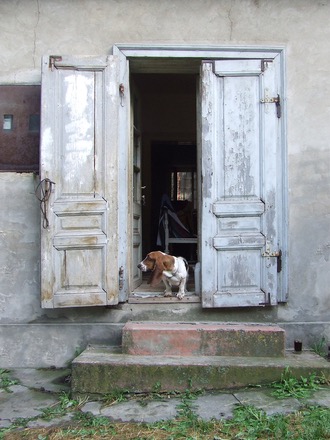
Follow these steps:
- Stand in front of your dog, your dog can be seated or standing, that is not important as far as I am concerned.
- Make sure you are truly in front of your dog AND that you can use your body to block the door should your dog break the wait.
- Unlock the door and have it just a tiny bit open, perhaps enough for a mouse to go thru but not your dog.
- Tell your dog: Fido, wait!
- Show your dog seconds AFTER you have said wait, your hand with fingers straight up and palm facing your dog.
- Open the door a bit more, say 1/4 of the way to a full open door.
- Now release your dog to go through the door.
- Give your dog a treat by mouth once outside or for more “impact and fun” throw it in front of your dog so he has to find it.
- At this point your dog should only stay put between 1 to 2 seconds before you release him or her. More than this and your dog will fail.
The most difficult thing to teach in most behaviors is duration. Which means for how long the dog has to do the behavior, so adding time that your dog has to stay without moving forward will be added SLOWLY and only as your dog is successful for 5 trials (tries) out of 5 at the current time criteria of 1-2 seconds. You will add seconds one at a time until your dog can stick it for 5 seconds before you open the door any wider.
Practice with your pup with lots of internal doors- not the front door just yet.
As you see that your dog has understood the game, begin to open the door more and more- which you guessed it, makes it more of a challenge for your dog.
- Go back to asking your dog to wait followed by your hand cue.
- Also, be ready to body block and reset again.
- If you are positioned correctly, you should be able to not only body block your dog but also close the door.
- Do lower the amount of time (seconds) your dog must stay put once you begin to open the door more. We only want to increase the difficulty of the exercise by changing one criteria at the time.
- When you are both ready for the front door: lots of successful reps where your dog can stay put for 5 seconds, you will repeat the steps above BUT with your dog on leash.
Wait from the car:
When practicing in the car, the steps will be the same. Please begin to practice with your dog on leash and in a traffic-free area. Depending on the type of car you have how you will handle the opening of the car door. Either way make sure you can block your dog with your body or by safely closing the door to avoid escape.
The video below illustrates the training plan. Have fun.


