Slice of Life is inspired by the desire and challenge of living our lives in the moment. Days go by, weeks go by, years... but we can still choose over and over again to look at our own lives in small installments. These installments (or slices of life) can be walks taken in the hills, naps or a glass of Rioja. For me, what makes my slices super meaningful is being able to share with others the moments of my day with dogs in play, training or napping where we're all piled up on the bed.

My slices of life are full of events and experiences that are meaningful to me. As a former professional photographer, I still “see” so many pictures (or vignettes) as I interact with my dogs and the world around me on a daily basis. Most of the time I am not capturing these moments with a camera anymore. Instead, I am just showing up... I must say, that I do miss having a register of events outside of my head so that at my leisure I can relish a past moment as I am transported by a visual or written recollection of days gone by.

With the immediacy of all things digital, perhaps I can have my cake and eat it too. I can continue to do my work as a dog trainer and also register here and there moments of living a life in the company of dogs. I hope you will occasionally take a peek, and that my slices of life transport you in a glee of YOUR own!

Showing posts with label learning. Show all posts

Monday, October 5, 2015

Does Punishment Work? Part 2

As promised, the conversation as to if punishment works continues. Before I dive into the explanation and exploration of this topic, I want to make my position clear: I DO NOT ENCOURAGE OWNERS TO PUNISH THEIR DOGS. INSTEAD I ENCOURAGE PEOPLE TO LEARN HOW TO USE EFFECTIVE AND HUMANE METHODS TO GET TO THE SAME RESULTS.

I am writing about this important topic because I realize that people are punishing their dogs. What’s even more heartbreaking is that most people, and a large number of professionals, do not understand how to effectively apply punishment which also makes it even more cruel for the animal *(&^^)%$#.
I strongly suggest that if you are going to use punishment with your dog, you invest the time and energy to learn how to do so! And as you will see it is not that simple… The rendition below is based on the Science of Animal Learning. It is not speculation, wishful thinking, and bleeding-heart thinking. Instead, it is based on many, many studies and experimentations on animals and their learning. Some of these experiments were so unethical that they are not allowed to take place in the name of science anymore!


Conditions of Effective & more humane (?) - You decide Punishment:
Based on Dr. Pamela Read book: Excel-erated Learning
  • Punishment should be a learning tool and not a means of revenge. If your dog is not learning as a result of using fear, pain or intimidation then it is not really punishment it is callous revenge.
  • Punishment MUST be initially SEVERE. Let me say that again, PUNISHMENT MUST BE INITIALLY SEVERE. Yes, I know, all those shock related products advocate for starting “small” and increasing the shock or whatever mechanism is being used to inflict pain, discomfort etc. as needed. But what these manufactures do not understand (or fail to report - as the case might be) is that this is not how punishment works.

The rationale behind this is that punishment should be strong enough to create an impression on the dog. It hurts so much, scared so much that the dog chooses not to engage in “x” behavior for fear of being hurt again, etc.

In other words, the behavior we choose to modify has been suppressed.

Now, here is the rub: Very few individuals (yes, unfortunately they are quite a few cruel people out there :() will not have the stomach to really use severe punishment. And, even if the person really is trying to help the dog by applying this rule of learning, we are left with another practical and ethical conundrum: How strong is strong enough? How can we measure this?

If less severe tactics are employed, in the name of being humane, the problem is that the behavior will not be suppressed long-term.

Another interesting twist to this dilemma is the fact that some animals will adapt to pain… so here we have to crank the pain outlet even more. Ouch! Real ouch!

Thirdly, when an owner produces a mild punisher, the response as discussed above will be lukewarm but it might be present, which in turns reinforces the owner to continue to punish the dog. What a sad life for both of them…

The presentation of punishment should be timely. Any delay in this presentation will be ineffective.
Consequences must be presented immediately and as a consequence for behavior in order for a dog to learn to link these two events together. Again, failing on this will not only constitute lack of learning, (suppression of behavior) but frankly how unfair can this be! The dog has no idea why he is being mistreated. So in choosing a punisher, we must consider the immediacy of the delivery. This is at the crux of fair/correct use of punishment.

The punishment must happen EVERY-SINGLE-TIME-THE-DOG-ENGAGES-IN-THE-BEHAVIOR… good luck with that! Last time I checked people in general have such a difficult time being consistent with anything. To put this one differently: The more times the behavior is followed by a punisher, the less likely the behavior will occur - the dog has learned something.

The punisher is always part of the punishing process. It is very difficult to separate the pain, etc. from who is delivering the blow. So bad news for the owner because most likely the dog will become to associate him or her with pain, fear, etc. (This is, of course, thanks to classical conditioning or associative learning - one of the most powerful ways of learning for creatures).

The punishment rarely teaches the dog an alternative. I HATE this! So the animal is getting hurt but does not know what to do instead. Oh, how very wrong!! The moral of this one point is to make sure we give the dog an out. We teach her what she can do instead to save her skin from pain.

Last, a very real and cruel result of using aversives to teach animals is that it is quite possible to end up with an animal that does not “behave” because it has learned - if punishment is not elegantly applied, that behavior produces pain and there is no sure way of escaping it. What is even more troubling is that many owners want a dog that does not behave. The animal’s joie de vivre gone!
I sure hope that writing about this topic makes people think many, many times prior to taking the “easy” (easy for whom?) way out.

Remember: Before you expect your dog to learn something ASAP, be honest with yourself about how painstaking it is to learn new stuff or go about making meaningful long lasting changes to your behavior. As such, let’s hope that we practice empathy for our dog's learning curves -especially when it comes to emotional issues (anxiety, fear) that are truly out of our dog’s control.
 

Monday, September 21, 2015

Feedback Loop

I am reading an article in Outside magazine “The Metric System”, October 2015 (pg. 50) about exercise gadgets and studies as to why most people abandoned the gadget all together. I won’t spoil it for you, but one of the reasons why this happens according to John Bartholomew, professor of Health Education at the University of Texas at Austin, who specializes in exercise psychology, is because what is needed in order to change behavior is: action, measurement, learning and modifying. In other words, there must be some sort of feedback loop.

As I am reading the article I am smiling because I can very well relate this to how dogs learn. Their feedback must come in a form of a consequence delivered immediately after the behavior. If there is one aspect that most dog owners fail to realize as they struggle to teach their dog anything is this. If instead of agonizing over the possible reasons why their dog is not following through (dog is stubborn, not smart, lazy, dominant, etc.) and instead they give their dog concrete feedback (a consequence) they would begin to get the results that they want.


Consequences are a part of life: Dog comes when called and he gets a treat or an opportunity for another ball toss. Fails to come and the fun ends when the leash appears. Dog waits politely for its meal; the food bowl is lowered, etc. Consequences must follow a few rules in order to be effective:

1. Must be delivered timely - not minutes after or worse hours after the behavior has taken place. This is meaningless to the dog when it comes to linking desired behavior to consequence and in some cases plain cruel. Think of the dog that for whatever reason eliminates inside and hours later he is admonished for this. In the eyes of the dog the owner is turning nasty over him coming to say hello, etc. Nope, they are not feeling guilty, that guilty look is an appeasement gesture since the dog is feeling threatened and wants to diffuse the situation.

2. We must deliver them consistently in order for the dog to continue to act in the manner we want him to and not deliver the consequence when it is convenient, etc.

3. They must not harm the dog, scare the dog or intimidate him. The best way to ensure that we can still exercise a consequence in order to teach the dog what we want him to do without resorting to pain or fear is to remove something that the dog wants such as: the ball that I toss for him to retrieve, opportunity for moving forward when pulling on leash, door closes when I see the dog trying to dash out, etc.

This morning I am playing with my dogs and I asked Rio to stop playing with the ball by herself – which she loves to do, and instead bring it back so that we can all play, but she refused. I walked towards her and in spite of her cute expression I gave my game over cue. I picked up the ball and walked away. Learning to give the dog feedback is at the crux of communicating appropriately with them. It is like a conversation we have with a good pal. We don’t abandon the dog to try and figure out what the heck we want. No, they don’t read our minds. Instead, we are well advised to exercise a little courtesy to the dogs in our lives as we addressed their behavior and our expectations with clarity. Exercising consequences for behavior offered does just that.

Monday, July 29, 2013

Back to Basics

Coming when called is such an important behavior -  especially when certain distractions are present that I am putting on the breaks of letting Deuce run free (off-leash) until he is more keen in giving me his attention – eye contact on a regular basis no matter what is going on around us!

I have found that some dogs are hyper- stimulate by their environment that they kind of truly “forget” that someone actually drove them to the beach or the trail and they would be happy as clams if they could just be dropped-off and picked-up when they are done… many hours later. Not the dog’s fault really, just being a
dog… following their noses religiously, making sure they leave their mark on every single shrub and chasing after anything that moves. The bottom line however is that whatever behavior one reinforces…the more of that behavior will be [come] the “default” behavior. This applies just the same to cracking the difficult nut of having your dog return to you when you want or need him to.

I teach recall classes (come when called) at least twice a year because they are fun, I have a great place to do so and people really know they need to have their dog and them learn the skills to become successful at this. So these days, Deuce is being put through the same program I teach. It also makes me feel good that
I am keeping it real by evaluating where Deuce needs more help and more training AND in moving forward with the training.


What it has been reinforcing for me is that in just two outings he is beginning to “get it”. Now he is beginning to realize that I actually chose the trail and took him and Rio there. I take his glances as his “acknowledgment” that I was the one with the brilliant idea of taking a hike and the one with the clicker, the treats and tug toy.

One of my biggest challenges here is Deuce’s over-stimulation and curiosity of his surroundings that even the best treats are second best. So sticking to a good dose of common sense and learning theory (how animals learn) is of the utmost important. I must very carefully plan our sessions/outings and control his environment to a “t”. In other words: no free lunches until he has been handsomely reinforced for minding me and coming back when called at rocket speed.

As I have expressed in many past blogs, the experience of working with dogs- especially my own becomes a parallel process with my own learning, my flexibility, frustration and yes, elation.

Most importantly, regardless of what I am feeling at the time of training it is super important that I remain focused on the process. This is how we move forward. How we get results. Reminding myself that the process of learning is never just linear (from point “A” to “B” to…) without turns, stops and hills is essential. Sort of two steps forward, one backwards and more discovery and challenges. What I am doing with Deuce is relatively straight-forward: No off-leash romps until… we improve Mr. and click every single time he
choose or I ask him for eye contact, followed by a reward of walk (and explore within the constraints of a longish leash) or a piece of a very tasty and novel treat. Sure enough two outings and his eye contact is becoming a default response… the key to moving forward, investigating and some food.

As Deuce offers this behavior more regularly I call him for a quick recall followed by a quick release… because really, who wants to hang out next to mom when you are young, handsome and restless? So I get it and I let him go.

Monday, July 22, 2013

Frisbee Dogs

Teaching your non-interested dogs to play with a Frisbee is similar to having to choose which chocolate to eat from a box of chocolates.

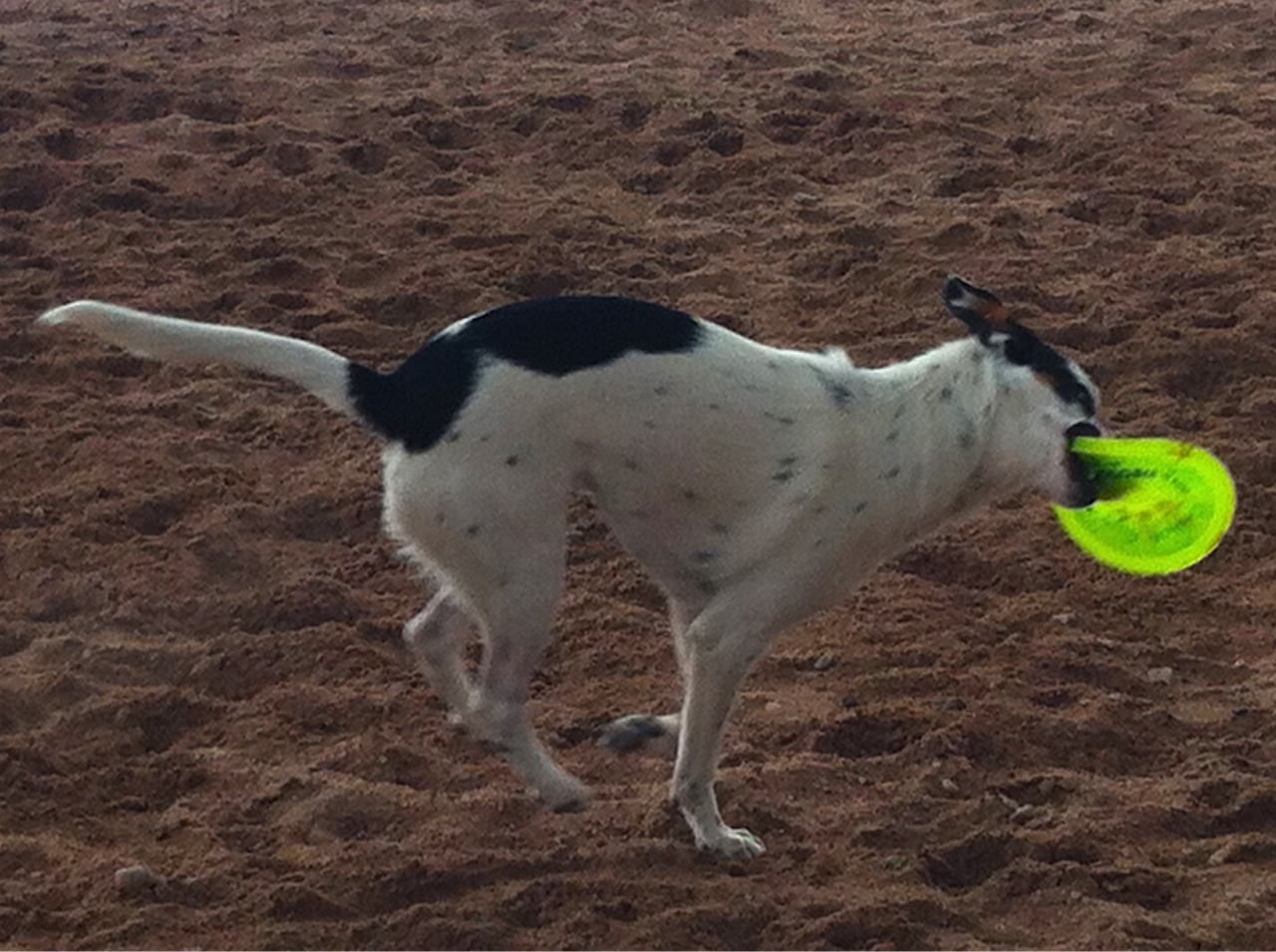
This morning as is our routine, I played/trained Deuce and Rioja before it got too hot. I have been working on teaching them how to play Frisbee. Believe it or not, the first few times I threw the Frisbee they looked either away from the flying disk with complete lack of interest or they looked at me in search of an explanation. Needless to say, I was crushed! My two athletic, super motivated dogs who'd do anything fun had no interest in the Frisbee!

It was clear to me after a few throws that this technique was doing nothing to peek their desire to chase after it. Suddenly it dawned on me to attach the Frisbee to a whippet since they both love to play with them and emulate as best I could the motion of a Frisbee. That worked like a charm and in just a couple of playing/training sessions both dogs were eager to be the one chasing the object.

I continued building a strong history of reinforcement with the Frisbee attached to the whippet knowing that at some point I needed to try my luck and throw the Frisbee as it is intended to be used and hope that both dogs jumped into action.

See how teaching your dogs to play with a Frisbee (or pretty much any kind of training) resemble choosing which chocolate? The experience is full of expectations and surprises!

I just got a new Frisbee that is made of a soft plastic that both dogs can pick up from the ground with no problem - an issue I did not anticipate when I began throwing the Frisbee for them.

Yesterday I played again with them just before dark and again this morning. I carefully noted what I needed to do for both of them so that they continue being interested in chasing the disc, being able to catch it midair as well as observing what they normally like to do once they are in possession of the toy.

There different personalities require that I pay attention so that I can design an individual training plan for each.

For example, when Rioja is in possession of the Frisbee she loves to run around (and away from me) with it in her mouth. When she does that she resembles more a young colt just out of the confines of the stable than a dog.


I have to be mindful not to immediately ask her for the toy or call her back to me so that we can begin the game again. Instead I thought, it is important that she gets to do something that she finds really fun after catching (or attempting to catch) the Frisbee.

The fun that she is having while going after the object and her little colt impersonation will translate later in a dog that is thrilled about catching and bringing the Frisbee back to me but first things first. We build behaviors slowly.

In essence, in the beginning stages of training something elaborate like playing with the Frisbee, it is important to keep things fun. Besides engaging the dog with the activity when I stop directing their every step, I get an opportunity to learn more about them: what do they like to do? What do I need to work on more? Etc.

Deuce, for example, is learning very well how to leap in the air as I throw the Frisbee in front of him close by. Keep in mind that is not necessarily “obvious” for a dog to be able to just grab the flying object. They too need to learn to coordinate their body in addition to running or jumping with speed. Speed and precision are the name of the game and dogs must learn this too!

Deuce does not run around excited with the toy, instead after jumping and catching it, he goes and lays in the shade anxious to have another go at it. He needs to bring the Frisbee back to me instead of expecting for me to go retrieve the disk. Having more than one Frisbee will solve this problem.

Since Frisbee throwing is also a new activity for me, I am experiencing the three of us learning at the same time. The mental notes that I take as I work with them are teaching me about their strength and weaknesses besides laying in front of my eyes the process of learning a new skill. The expectation of having them learn something new, or becoming proficient with a task keeps me wanting more. Not knowing how the session will progress keeps me focused, constantly checking my expectations with
their present abilities.

Monday, May 20, 2013

Flexibility

I was talking to my sister on the phone and among the topics covered we were exchanging stories of our dog’s latest mischievous activities. As I was describing Rioja’s I heard myself telling my sis that Rioja is more “flexible” in her learning than Deuce. Later on I was thinking about what I meant by “being more flexible." I wondered about this for the next couple of days.

So this is what I mean by “flexibility” be it for learning or as a temperament trait if you will. I will give you an example involving Deuce and Rioja: As I have written in a past blog post: Deuce It’s Soccer, We are Playing Soccer, it took me literally months to teach Deuce how to retrieve and bring the ball back to me. I won’t repeat here what it all entailed, but I will just mentioned that one of the major stumbling blocks I had with Deuce was that if the ball was not kicked in a certain direction, in relation to where Deuce was laying he would not go after the ball. If Laika was nearby, or Rioja now for that matter, Deuce refuses to engage with the ball. The conditions for his retrieving of the ball had to be just "right."

Figuring out what “just right” meant for Deuce required flexibility on my part. Similarly to the example above, Deuce’s willingness to eat out of food dispensing toys is contingent upon “certain Deuce rules”… He will only eat out of them if he has spectators- be it Rioja or myself. I think he has made a game out of "terrorizing” Rioja with a game of “I got a food/toy and you don’t” kind of a thing. And since she is the opposite, and will engage with the food dispensing toy with gusto finishing her meal in a flash.

Here goes another example: Deuce will only jump on the bed to say “hello” to us in the morning when he wants to regardless of how much calling and inviting we do. Once he is on the bed, he will only stay on the bed for a few minutes regardless of how much coaxing we do. He has trained me (John is still a “work in progress”) not to ask him to come to bed to visit with me. Instead I reinforce him for doing so.


Of course, it is so easy to think that Deuce is just begin “stubborn." This is one of the reasons I hear frequently as to why our dogs refuse to do what we ask them to. However, I beg to differ. Not so much in defense of Deuce, but I differ based on what science tells us about animal learning and the role of motivators for an animal to engage in behaviors or in learning.

Any living animal (including humans) must be motivated to partake in a given behavior. Period. The motivation, of course, varies depending on the environment and the needs of the individual at a given moment.

Are motivators internal processes or external? You might ask. And the answer is that they are both. We are always in relation to our environment, learning and living do not take place in a vacuum, but at the same time because motivators are valuable to the individual then they are also internally driven. Now back to dogs and flexibility – (or lack of thereof) Rioja in my experience is more flexible when it comes to training. I notice this by her ability to respond with less effort to changes in contingencies. It amazes John and me alike how quickly she learns and adapts!

When it comes to our training sessions, regardless of what the content or my goals for the sessions are, I must plan my training with Deuce very carefully. Even so, Deuce very often surprises me with his responses. I also plan ahead of time my sessions with Rioja as I think that everyone training their dogs should for the sake of clear communication. It is true that sometimes Rioja also surprises me with an unexpected response but so far I find her responses to my requests more “predictable.”

Here is another example of a recent session. As I am working with Rioja, Deuce is auto-feeding from a food dispensing machine in the same room behind a baby gate. Just about the time Deuce’s meal is over, it is time for me to switch the dogs. Rioja will eat kibble from the machine behind the baby gate and Deuce and I will train (with higher-value “stuff” otherwise he will not work- Rioja is good to working with the same kibble she just gobbled at the machine). Normally both dogs would rather be training than eating out of the machine but they have also learned that their turn will come. Now this particular morning, Deuce decides that he wants nothing to do with me no matter how yummy the treats or how “fun” and engaging the training session. He decides instead to stare at Rioja and whine expressing frustration over not working with the feeding machine.

What gives Deuce? You just spent a few minutes eating boring kibble from it! So I put him on leash and walk him to our training spot. He is still unmotivated to train. I change gears- testing my own flexibility and I engage him next to where Rioja is eating in a furious game of tug- now he is working! My goal here is to have him engage in a super rewarding behavior (tugging is way up on his list) when Rioja is with the machine/toy thus creating a positive association for Deuce of Rioja and the toy - something he struggles with most of the time but not all the time (ai-yay-yay).

Being flexible or not has nothing to do with how “smart” a dog is. I think that in part what is at play is the dog’s breed. Is the dog a “full”- breed or a “mix”? Of course the particular make-up of the individual is also relevant.

Now, if we look at breed-specific behaviors we can clearly identify what are called Fixed-Action-Patterns (FAPs). In essence FAPs refers to how a dog’s brain is “wired.” FAPs are stereotypical behavior sequences that require no learning and which are ‘triggered’ or displayed when a releaser (a given stimulus) is presented. Some FAPs are breed specific, but not all. When it comes to breed specific FAPS … retrievers will point at prey, herding breeds gather (or herd) stock, terriers will hunt prey by going underground, etc. In the case of Deuce, a full Border Collie, his lack of “flexibility” I think, is a result of a “spilling-over” of typical herding-dog behaviors into other kinds of training or even everyday activities. This is just a “hunch” more thinking/research on this theory is needed…

My “job” however, is to notice the dogs different learning be it my own or a client’s so that the learning experience is efficient and with the least “wear and tear” for the dog.

Nicely so, their different learning modalities keeps my own flexibility in check! I have a policy when training, which if a dog I am working with makes three mistakes in a row- mistakes from my point of view or my goals-not the dog’s I must acknowledge this and change something. This is what I mean by “wear and tear.” Of course all learning involves some level of frustration but if the dog (or horse, human etc.) finds the learning experience too frustrating or stressful no learning will take place.

Training dogs never ceases to surprise me! Through the process of interacting with dogs and our working and learning together I can better “witness” my own process (am I being flexible etc.?) Once I have been made aware of my own approach during the training session (or when not formally training but just interacting with the dogs) I need to find creative ways to reach my goals while honoring the individual dog I am training- and that for me makes getting up in the morning really worth the shot.