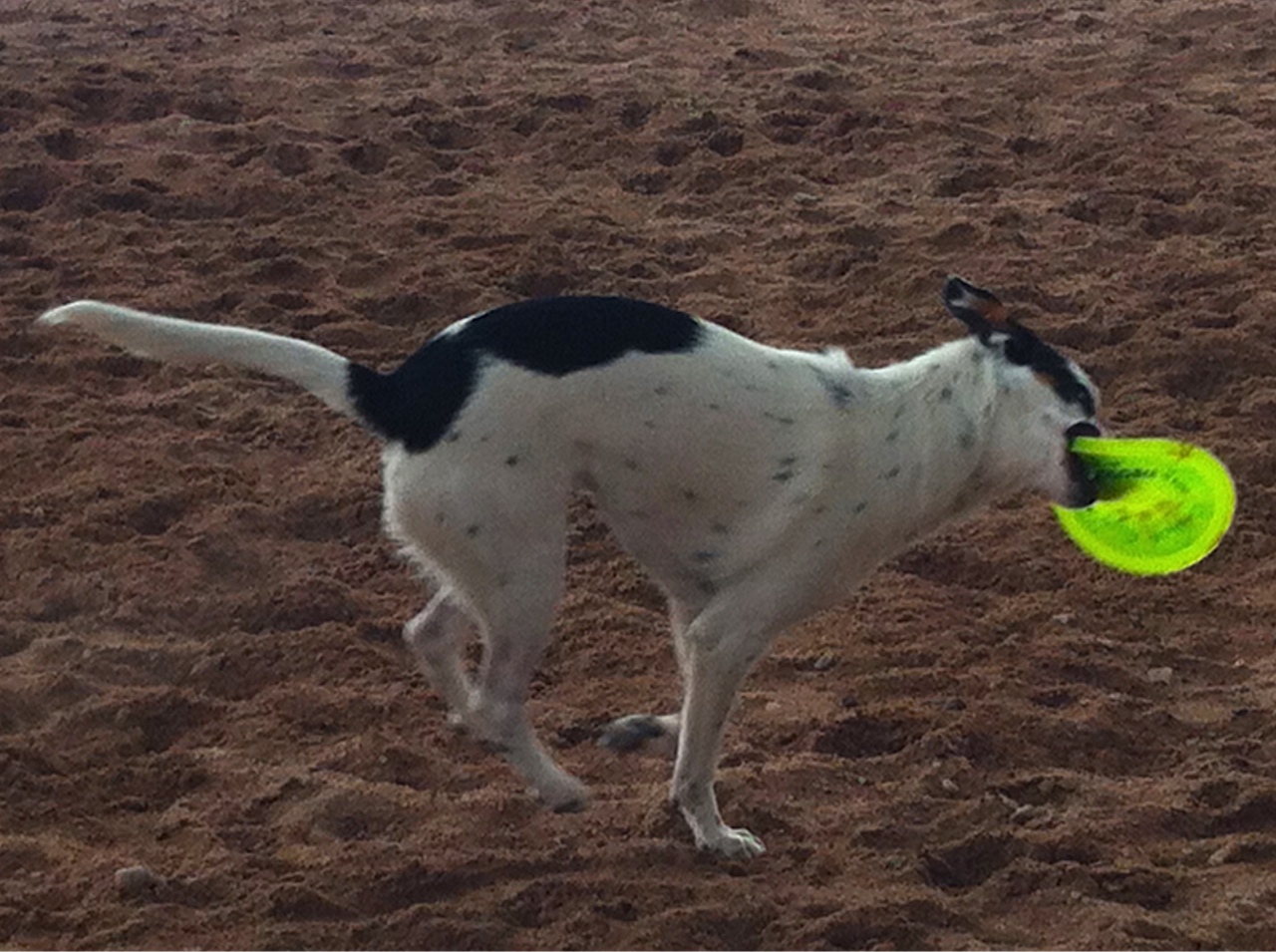
Since Deuce has been recuperating from his knee ligament injury I have modified a few of our training and playing activities. This morning for the first time in a few weeks I bring out the big orange ball, the tug and whippet.
Deuce runs into position and is anxiously waiting for me to kick the ball far. Rio, who is nearby, is focused on the whippet.
I begin to move the whippet ever so slowly just before kicking the ball for Deuce when I noticed that Rio looses interest on the whippet and is now next to Deuce ready to run after the ball as well.
Ahh… I think to myself - the orange ball has become a visual cue as to what kind of game we are playing. For the past few weeks it was tennis balls for Deuce and the whippet for Rio in addition to her large red ball, which she loves playing with.
I am kind of at awe at her clever response to this environmental/visual cue. With the orange ball in place the game is that both dogs run after the ball with Rio then running hard towards me to either play with the whippet or tug, leaving Deuce with the big orange ball.

Once I am made aware of Rio’s “intentions” I comply and begin playing with them. As I kick the ball and entice Rio with the whippet, the whippet got me thinking about the verbal and environmental cues that I make the habit of using in an effort of communicating clearly with them.
Some of my favorite verbal cues (which are also paired with visual cues such as me standing or walking away, retrieving toys etc.) is my “ready to work?” cue paired with me standing next to whatever props I will be using during the training.
However, when they are running hard I want them to take breaks often - especially if it is hot. Deuce requires more breaks than Rio, perhaps because he has dark, long hair.
Regularly he cues me by lying down in the shade waiting for me to verbally offer them a break, which I do by saying: "take a break” as we stop all activity. We resume once I notice the dogs have had their rest.
When our games or training session is over, I always end with: "All done!" This is followed by my gathering of the toys and walking towards the garage/training classroom where the toys are kept. Rio never fails to approach the water bowl once I have signaled we are done for the moment ignoring whatever toys are still in her path.
But Deuce sometimes lays incredulous with his ball next to him or in his mouth – hoping perhaps that he “heard wrongly” and the game will continue. I am amused by his typical response and ask him to join me as I continue walking away.
Because I work and play with both dogs at the same time, I need to communicate to them when their turn is to engage in play or training and when they need to rest.
We have practiced in different locations the resting and active roles so that they both learn that laying quietly on a bed – made available for this purpose means that they will get reinforced for stationing (staying put in one specific place). By now the know that my verbal: switch requires them to either rest or take center spot. This type of training (stationing) is often used in zoos and aquariums where the norm is for a trainer to work with multiple animals at the same time (sigh)!
It is crucial to use environmental and verbal cues so that the dog is not left in “limbo” wondering what the heck she is suppose to do now. In this manner you avoid undue frustration and confusion making training and play not only more efficient, but also fun.
Deuce runs into position and is anxiously waiting for me to kick the ball far. Rio, who is nearby, is focused on the whippet.
I begin to move the whippet ever so slowly just before kicking the ball for Deuce when I noticed that Rio looses interest on the whippet and is now next to Deuce ready to run after the ball as well.
Ahh… I think to myself - the orange ball has become a visual cue as to what kind of game we are playing. For the past few weeks it was tennis balls for Deuce and the whippet for Rio in addition to her large red ball, which she loves playing with.
I am kind of at awe at her clever response to this environmental/visual cue. With the orange ball in place the game is that both dogs run after the ball with Rio then running hard towards me to either play with the whippet or tug, leaving Deuce with the big orange ball.
Once I am made aware of Rio’s “intentions” I comply and begin playing with them. As I kick the ball and entice Rio with the whippet, the whippet got me thinking about the verbal and environmental cues that I make the habit of using in an effort of communicating clearly with them.
Some of my favorite verbal cues (which are also paired with visual cues such as me standing or walking away, retrieving toys etc.) is my “ready to work?” cue paired with me standing next to whatever props I will be using during the training.
However, when they are running hard I want them to take breaks often - especially if it is hot. Deuce requires more breaks than Rio, perhaps because he has dark, long hair.
Regularly he cues me by lying down in the shade waiting for me to verbally offer them a break, which I do by saying: "take a break” as we stop all activity. We resume once I notice the dogs have had their rest.
When our games or training session is over, I always end with: "All done!" This is followed by my gathering of the toys and walking towards the garage/training classroom where the toys are kept. Rio never fails to approach the water bowl once I have signaled we are done for the moment ignoring whatever toys are still in her path.
But Deuce sometimes lays incredulous with his ball next to him or in his mouth – hoping perhaps that he “heard wrongly” and the game will continue. I am amused by his typical response and ask him to join me as I continue walking away.
Because I work and play with both dogs at the same time, I need to communicate to them when their turn is to engage in play or training and when they need to rest.
We have practiced in different locations the resting and active roles so that they both learn that laying quietly on a bed – made available for this purpose means that they will get reinforced for stationing (staying put in one specific place). By now the know that my verbal: switch requires them to either rest or take center spot. This type of training (stationing) is often used in zoos and aquariums where the norm is for a trainer to work with multiple animals at the same time (sigh)!
It is crucial to use environmental and verbal cues so that the dog is not left in “limbo” wondering what the heck she is suppose to do now. In this manner you avoid undue frustration and confusion making training and play not only more efficient, but also fun.